
 ultimate-guide
Chronic Back Pain Treatment for Women: A 2026 Guide
Table of Contents
- Why Chronic Back Pain Hits Women Differently
- Common Causes of Back Pain in Women
- How to Describe Your Pain So It Gets Taken Seriously
- Heat or Ice for Back Pain: What Actually Helps
- Chiropractic Care for Chronic Back Pain: What to Expect
- Non-Surgical Treatment Options Beyond the Chiropractic Table
- Medication, Injections, and Physical Therapy: Where They Fit
- When to See a Doctor for Back Pain
- Red Flags That Need Urgent Medical Attention
- Preventative Measures That Protect Your Back
- Building a Treatment Plan That Fits Your Life
- Frequently Asked Questions
Last Updated: October 21, 2026
Why Chronic Back Pain Hits Women Differently
Chronic back pain treatment for women is not simply a scaled-down version of the care men receive. Anatomy, hormonal history, pregnancy, bone density, and the way pain signals are processed all shape what a woman's back pain feels like and which treatments work. At Alpha Total Health in Lady Lake, FL, we have spent more than 29 years watching these differences play out in the treatment room, and they change how we build a plan.
Chronic back pain is defined as pain in the thoracic, lumbar, or sacral spine that persists for 12 weeks or longer, with or without a clear triggering injury. That definition matters because it separates a strain that heals on its own from a pattern that needs a structured approach.
Here is the part most guides get wrong: they treat "back pain" as one condition. It is not. A 68-year-old woman with osteoporosis and a compression fracture needs a completely different plan than a 45-year-old with disc degeneration and a desk job. Below, we break down the causes, the treatment options, and how to describe your pain so a clinician takes it seriously the first time.
Common Causes of Back Pain in Women
The most common causes of back pain in women fall into two broad groups: hormonal and bone-health factors, and lifestyle or occupational triggers. Most patients we see in Lady Lake are dealing with some combination of both, which is why single-cause explanations rarely hold up.
Hormonal Shifts and Bone Health
Estrogen plays a protective role in bone density and in how the body regulates inflammation. When estrogen declines during perimenopause and menopause, bone loss accelerates and spinal structures become more vulnerable to compression and stress. Women with a history of pregnancy also carry a higher lifetime load on the lumbar spine, and diastasis recti (separation of the abdominal muscles) can leave the core less able to support the lower back.
Osteoporosis deserves special attention. The National Institute of Arthritis and Musculoskeletal and Skin Diseases notes that postmenopausal women are at elevated risk for vertebral compression fractures, which often present as sudden mid-back pain rather than a gradual ache. If your pain started abruptly and feels like a band around your ribs, that pattern is worth mentioning to your doctor.
Lifestyle and Occupational Triggers
Central Florida's active retiree population gives us a useful window into the second group. Golf, pickleball, gardening, and long days of standing all load the spine in repetitive ways. So does the opposite: prolonged sitting in a recliner or at a computer shortens hip flexors and deconditions the deep core muscles that stabilize the lumbar spine.
A common mistake is assuming that pain after activity means the activity is the problem. Often the activity simply revealed a weakness that was already there. We see this constantly with golfers whose back pain appears only after the third or fourth hole. The swing is not the cause; it is the stress test.
How to Describe Your Pain So It Gets Taken Seriously
Vague descriptions get vague care. If you tell a clinician "my back hurts," you will get a generic answer. If you describe the pattern, location, timing, and what makes it better or worse, you get a targeted plan.
Use this framework before your next appointment:
- Location: Point to it. Is it central, off to one side, or does it wrap around the ribs?
- Quality: Sharp, dull, burning, aching, or electric?
- Timing: Worse in the morning, worse at night, worse after sitting, or worse with activity?
- Radiation: Does it travel into the buttock, thigh, or foot?
- Triggers and relievers: What makes it better? What makes it worse?
- Function: What can you no longer do? Walking distance, sleep, lifting groceries.
Heat or Ice for Back Pain: What Actually Helps
Heat or ice for back pain is not an either-or question. The general rule most clinicians follow is ice for acute inflammation in the first 48 hours after an injury, and heat for chronic muscle tension and stiffness. For chronic back pain, which is what this guide covers, moist heat is usually the more comfortable and more useful choice.
Here is the reasoning. Ice constricts blood vessels and reduces swelling, which helps a fresh strain. Heat does the opposite: it dilates vessels, increases blood flow, and relaxes guarded muscles. In chronic pain, muscle guarding and stiffness are usually the dominant problem, so heat wins more often than not.
Practical guidance:
- Use moist heat for 15 to 20 minutes at a time, never directly on bare skin
- Never sleep on a heating pad, and never use heat if you have reduced sensation in the area
- If you have an acute flare with visible swelling, ice first for the first two days
- Neither heat nor ice treats the underlying cause; they buy comfort while you address it
Chiropractic Care for Chronic Back Pain: What to Expect
Chiropractic care for chronic back pain focuses on restoring motion in joints that have become restricted and reducing the muscular compensation that follows. It is not a cure for arthritis or disc degeneration, and any clinic that promises otherwise is overselling. What it can do is improve how the spine moves, which often reduces pain and improves function enough to let you do the strengthening work that actually changes the long-term picture.
What a First Visit Looks Like
A thorough first visit should include a health history, a physical and neurological exam, and a clear explanation of findings before any treatment begins. Expect questions about your menstrual and menopausal history, prior pregnancies, bone density scans, and medications, because all of these affect what is safe for you.
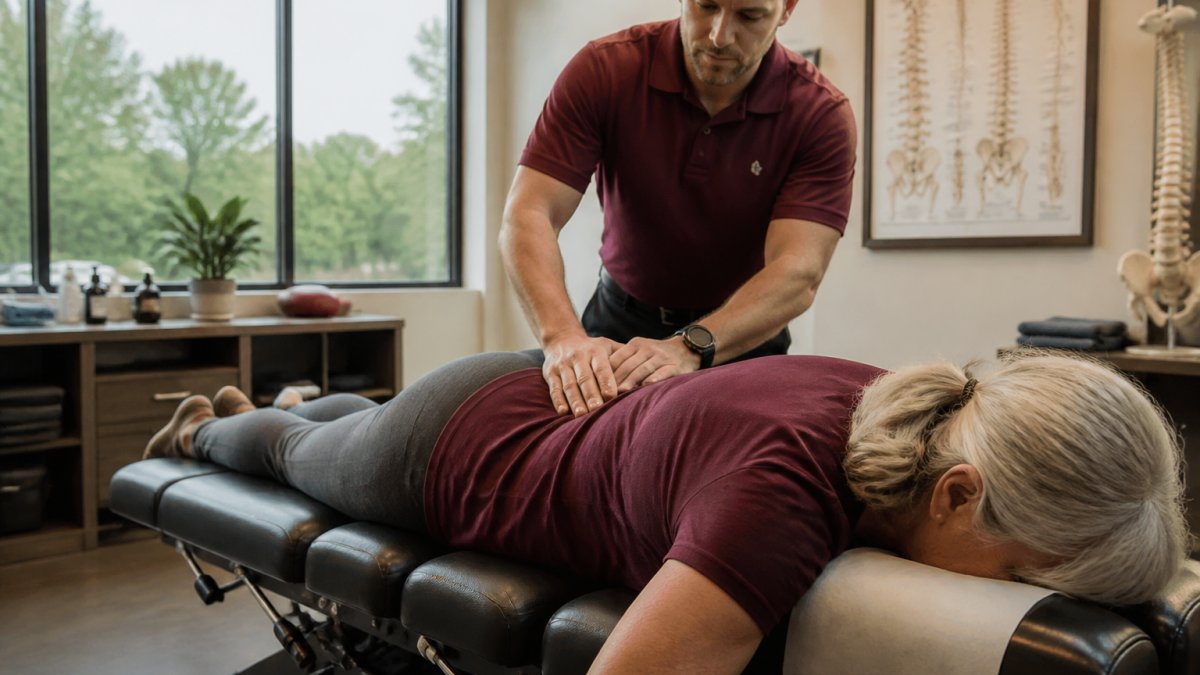
At Alpha Total Health, our New Patient Consultation Package is designed to introduce you to our expert, welcoming approach to care, including a health history, exam, findings, and a plain-language explanation of what we think is going on and what we would recommend. You should leave the first visit understanding your own back better than when you walked in. If you do not, ask again.
Non-Surgical Treatment Options Beyond the Chiropractic Table
The strongest non-surgical plans combine several approaches rather than relying on one. Manual therapy and joint mobilization address restricted motion. Targeted exercise builds the deep core and hip strength that offloads the lumbar spine. Regenerative therapies are offered at Alpha Total Health to support soft tissue healing, and patient selection matters enormously for these.
Spinal decompression is another option we evaluate for patients with disc-related pain that radiates into the leg. Not everyone is a candidate; fractures, certain surgical histories, and severe osteoporosis rule it out.
The American College of Physicians low back pain guideline recommends non-pharmacologic treatment as first-line care for chronic low back pain, which aligns with how we build plans. The throughline across all of these options is the same: none of them work in isolation, and none of them replace your own daily movement.
Medication, Injections, and Physical Therapy: Where They Fit
Medication and injections are tools for managing pain enough to participate in active treatment, not substitutes for it. Over-the-counter NSAIDs can reduce inflammation short-term, but long-term daily use carries gastrointestinal and kidney risks, especially in older adults. Muscle relaxants help with acute spasms but are sedating and not a chronic solution.
Injections, including epidural steroid injections, are typically reserved for radicular pain that has not responded to conservative care. They can provide a window of relief that makes physical therapy possible. They do not fix the underlying structure.
Physical therapy is the workhorse. A good program for chronic back pain includes graded strengthening, not just stretching. If your therapy consists only of passive modalities and table time, ask for a progression plan.
| Option | Best For | Typical Role | Key Limitation |
|---|---|---|---|
| Chiropractic care | Restricted joint motion, muscular guarding | Restore motion, reduce pain | Not a cure for structural degeneration |
| Physical therapy | Weak core, deconditioning | Build strength, prevent recurrence | Requires consistent home work |
| Medication | Short-term flare control | Bridge to active care | Long-term risks in older adults |
| Injections | Radiating leg pain | Open a window for therapy | Temporary, does not fix structure |
| Spinal decompression | Disc-related pain | Reduce nerve compression symptoms | Not for everyone; needs screening |
When to See a Doctor for Back Pain
When to see a doctor for back pain comes down to duration, severity, and associated symptoms. See a doctor if pain has lasted more than a few weeks despite rest and self-care, if it interferes with sleep or daily function, if it follows a fall, or if you have a history of osteoporosis or cancer. Women over 50 with new mid-back pain should be evaluated promptly, because compression fractures are common and often missed.
See a doctor the same day, or go to urgent care, if you notice any of the following:
- New weakness or numbness in a leg
- Loss of bladder or bowel control
- Pain accompanied by fever
- Unexplained weight loss alongside the pain
- Pain that is worse at night and does not ease with position change
These are screening triggers, not diagnoses. Only a clinician examining you can determine what they mean in your case.
Red Flags That Need Urgent Medical Attention
Cauda equina syndrome is a rare but serious condition in which the nerves at the base of the spinal cord are compressed. It requires emergency evaluation. Signs include sudden loss of bladder or bowel control, numbness in the saddle area, and rapidly progressing leg weakness. Do not wait for an appointment.
Other red flags include a history of major trauma, known cancer, intravenous drug use, or long-term steroid use combined with new back pain. Each of these raises the probability that the pain has a cause beyond mechanical strain.
Preventative Measures That Protect Your Back
Prevention for women's back health comes down to three levers: bone density, muscle strength, and daily movement patterns. Bone density is influenced by weight-bearing exercise, adequate calcium and vitamin D intake, and a conversation with your doctor about screening. The Bone Health and Osteoporosis Foundation provides current guidance on when to pursue a DEXA scan.
Muscle strength means the deep core, hips, and glutes, not just the abs. A simple daily routine of dead bugs, bird dogs, glute bridges, and hip hinges covers most of the ground. Two sets of each, most days, is enough to matter.
Daily movement patterns are the lever most people ignore. Break up long sitting every 30 to 45 minutes. Set up your golf bag or gardening tools so you lift with your legs. And if you are in the Lady Lake area and play pickleball several times a week, add hip and thoracic mobility work to your warm-up; the sport's quick lateral movements load the spine in ways that a general stretch routine does not prepare you for.
Building a Treatment Plan That Fits Your Life
The best treatment plan is the one you will actually follow. That means matching the plan to your schedule, your budget, your goals, and your tolerance for hands-on care. A plan that requires three visits a week for six months is not realistic for most retirees, and a plan that requires nothing of you at home will not hold.
We build plans around function first. What do you want to get back to? Golf, pickleball, walking the grandkids to the park, sleeping through the night. Those goals determine the intensity and the timeline. Pain relief is the first milestone, but restored function is the actual target.
Frequently Asked Questions
What is the best treatment for chronic back pain in women?
There is no single best treatment. Most women get the most relief from a combination of approaches: targeted exercise and physical therapy, hands-on care such as chiropractic adjustments, heat and ice for flare-ups, and changes to how they sit, lift, and sleep. The right mix depends on your diagnosis, your age, your activity goals, and how long the pain has lasted. A qualified clinician should assess you before you commit to any plan, and the plan should be reviewed if you are not improving within a few weeks.
Why is chronic back pain more common in women?
Several factors stack up. Women have a different pelvic structure and carry more load through the lower back during pregnancy and childcare. Hormonal changes around menopause affect bone density and joint stability. Women also report higher rates of certain conditions, including osteoporosis and fibromyalgia, and are more likely to work in roles that involve repetitive lifting or prolonged standing. None of these guarantees back pain, but together they help explain why chronic back pain is more common in women than in men.
Is heat or ice better for chronic back pain?
It depends on the stage. Ice is generally more useful in the first 48 hours after a new injury or during an acute flare-up, when there is swelling or sharp pain. Heat is usually better for chronic, stiff, achy pain because it relaxes muscle and improves blood flow. Many women alternate the two. Never apply either directly to bare skin, and keep sessions to about 15 to 20 minutes. If heat or ice makes the pain worse, stop and speak to a clinician.
Can chiropractic care help chronic back pain?
Chiropractic care can help many women with chronic back pain, particularly when the pain is mechanical, meaning it comes from joints, muscles, or alignment rather than from a serious underlying disease. A chiropractor will assess your spine, review your history, and may use adjustments, soft tissue work, and home exercises. Results vary. Chiropractic care is not a cure for every cause of back pain, and it should be part of a broader plan that includes movement and, where needed, medical review.
When should a woman see a doctor for chronic back pain?
See a doctor if back pain lasts more than a few weeks, keeps returning, or starts interfering with sleep, work, or daily activity. Seek care sooner if you have numbness, weakness, or tingling in your legs, pain that follows a fall or accident, unexplained weight loss, fever, or loss of bladder or bowel control. Those symptoms need prompt medical assessment. For long-standing pain, a clinician can rule out serious causes and help you choose between physical therapy, chiropractic care, and other options.
Do you accept walk-ins at Alpha Total Health?
Alpha Total Health is a storefront clinic in Lady Lake, and the practice offers a New Patient Consultation Package as an entry point. Walk-in availability can vary by day, so we recommend calling ahead to confirm a time that works for you. If you are booking your first visit, ask what to bring, including any imaging or medication lists, so the clinician can review your history properly. Do not delay urgent symptoms for a routine appointment.
What should I expect at my first visit?
A first visit typically includes a conversation about your pain history, a physical and postural assessment, and a review of any imaging or prior treatment. At Alpha Total Health, the New Patient Consultation Package is designed as an introduction to the practice and its approach. You should leave with a clearer understanding of what is likely driving your pain and what the next steps would be. Ask about costs and the proposed plan before you commit to ongoing care.
Can chiropractic care help sciatica and neuropathy?
Chiropractic care is often used for sciatica when the cause is mechanical, such as a disc or joint issue irritating the nerve. Neuropathy has many causes, including diabetes and nerve damage, and chiropractic care is not a substitute for a medical workup. Alpha Total Health offers a $49 Neuropathy Consult Visit and a $49 Spinal Disc Decompression evaluation, which can help clarify whether conservative care is appropriate. Always confirm the diagnosis with a qualified clinician before starting treatment.