
 ultimate-guide
How to Maintain Mobility After Sixty: A Complete Guide
Last Updated: November 4, 2026
Quick Summary
To maintain mobility after sixty, combine range of motion work, strength training, balance practice and daily walking, and build up gradually. Aim for strength training at least two days a week, balance practice three to four days a week, and about 30 minutes of walking most days.
- Mobility combines range of motion, strength, balance and coordination, so train all four.
- Start with seated exercises for two to three weeks before adding standing work.
- Do chair stands and wall push-ups for leg and upper body strength, at least two days a week.
- Practice balance three to four days a week, progressing from supported holds to single-leg stands.
- Fall-proof your home with non-slip mats, grab bars and nightlights, and speak with a health care professional before starting if you have health conditions.
Table of Contents
- Why Mobility Matters More After Sixty
- Understanding Mobility: Range of Motion, Strength, Balance and Coordination
- Mobility Exercises for Seniors: Where to Start
- Strength Training for Adults Over 60
- Balance Exercises for Older Adults and Fall Prevention
- Flexibility, Stretching and Joint Stiffness
- Low-Impact and Chair-Based Options When Movement Hurts
- Walking and Everyday Activity: How Much Is Enough
- A Progressive Weekly Mobility Plan
- How to Maintain Mobility After Sixty at Home
- Measuring Your Mobility Progress
- Common Mistakes and Exercise Modifications for Pain or Arthritis
- When to Talk to a Health Care Professional Before You Start
- Getting Professional Help in Lady Lake, FL: Booking Your First Visit at Alpha Total Health
- Frequently Asked Questions
Why Mobility Matters More After Sixty
Keeping your body moving freely is one of the most valuable things you can do after sixty. Read more about chiropractic care's role in maintaining long-term movement. Mobility, meaning your ability to move your joints through their full range and control your body during everyday tasks, directly affects how independently you live. Many people who want to keep up with grandchildren, golf, and daily chores without pain or fear of falling look for practical ways to stay mobile.
Many adults notice that movement starts to feel harder with age. Stairs take more effort, getting up from a chair takes longer, and stiffness lingers in the morning. These changes are common, but they are not always inevitable. Regular, well-chosen activity can slow many of these effects. The sections below explain how to build a practical plan.
Understanding Mobility: Range of Motion, Strength, Balance and Coordination
Mobility is not a single skill. It is the combined ability to move freely, with enough strength to control that movement and enough balance to stay steady. Range of motion describes how far a joint can move, such as bending the knee or reaching overhead. Strength provides the power to lift, rise, and carry. Balance keeps you upright when you shift your weight, and coordination helps your muscles work together smoothly.
Because these qualities depend on one another, training only one of them often leaves gaps. A person with flexible hips who cannot stand on one leg may still struggle on uneven ground. Working on all four areas gives the most complete benefit.
Mobility Exercises for Seniors: Where to Start
Starting slowly is the safest and most effective approach. Begin with gentle movements you can perform with a sturdy chair nearby for support. Spend about 10 minutes, two to three times a week, on simple ankle circles, seated marches, arm raises, and torso turns. Move within a comfortable range and stop if you feel sharp pain.
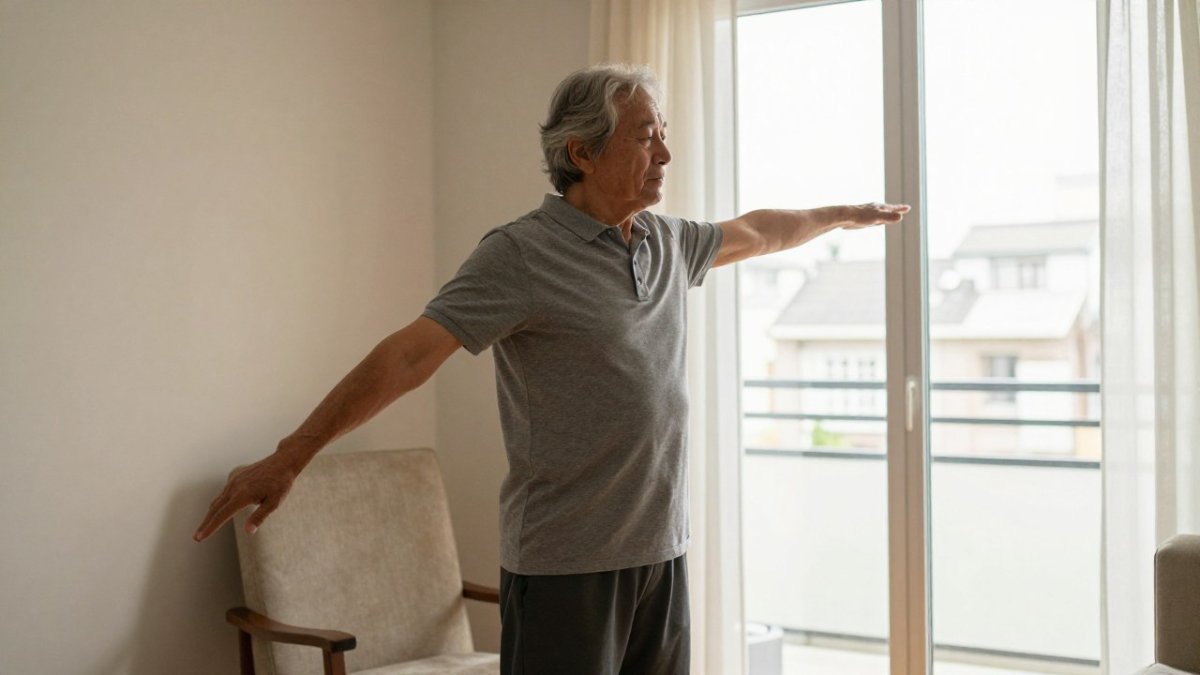
After two to three weeks, most people feel ready to add light standing work. Increase the challenge gradually rather than all at once. If you have a heart condition, joint replacement, recent surgery, or dizziness, check with your doctor before beginning a new program.
!An active older adult in a bright, sunlit living room performing a gentle standing stretch beside a sturdy chair
Strength Training for Adults Over 60
Muscle strength supports nearly every daily activity, from climbing stairs to lifting groceries. Strength training uses your own body weight, bands, or light weights to challenge your muscles. Even modest work can improve leg power and posture, and it helps protect muscle mass that tends to decline with age.
Aim to strength train at least two days a week, leaving a rest day between sessions. Focus on controlled movements and breathe steadily throughout each repetition.
Chair Stands and Wall Push-Ups
Chair stands build the leg strength you use to rise from a seat. Sit near the front edge of a sturdy chair with your feet flat, then stand up without using your hands if you can, and sit back down slowly. Repeat 5 to 10 times.
Wall push-ups work the chest, shoulders, and arms with less load than floor push-ups. Stand arm's length from a wall, place your palms on it at shoulder height, bend your elbows, and press back out. Complete 8 to 12 repetitions.
Glute Bridges and Planks
Glute bridges strengthen the buttocks and lower back, which support walking and posture. Lie on your back with knees bent and feet flat, then lift your hips until your body forms a straight line from shoulders to knees. Hold for two seconds and lower slowly for 8 to 12 repetitions.
Modified planks build core stability. Begin with your forearms on a counter or sofa arm, keeping your body in a straight line, and hold for 10 to 20 seconds. Progress to longer holds as your core becomes stronger.
Balance Exercises for Older Adults and Fall Prevention
Falls are a significant concern for older adults (the CDC). The good news is that balance is trainable at any age. A consistent balance practice, paired with home safety changes, can help reduce fall risk and preserve independence.
A Three-Level Balance Progression
Start at Level 1 and stay there until you can complete the exercise with steady breathing and no hand support for the full hold. Move to the next level only when the current one feels easy for a full week.
- Level 1, Supported holds: Stand behind a sturdy chair with both hands on the backrest. Shift your weight slowly side to side for 30 seconds, then front to back for 30 seconds. Next, march in place while holding on, lifting each knee to a comfortable height, for 30 seconds.
- Level 2, Single-leg stands with fingertip support: Stand near a counter and rest one fingertip on it. Lift one foot slightly off the floor and hold for 10 seconds. Repeat 3 times per leg, then switch. Work up to 30 seconds per leg. Keep your gaze on a fixed point ahead.
- Level 3, Dynamic balance: Practice heel-to-toe walking along a kitchen counter, holding on with one hand if needed, for 10 steps. Then try standing on one foot without hand support for up to 10 seconds. Add slow head turns while standing on one foot only after Level 2 feels stable.
Aim for balance practice three to four days per week, 5 to 10 minutes per session. Balance gains fade quickly if you stop, so consistency matters more than duration.
Fall-Proofing Your Lady Lake Home
Balance exercises only go so far if your environment works against you. In Lady Lake, afternoon rain can leave entryways damp. Practical steps include:
- Place non-slip mats in the bathroom and kitchen, and wipe up spills immediately.
- Install grab bars in the shower and beside the toilet; towel bars are not designed to bear weight.
- Keep a nightlight in the hallway and bathroom, and a lamp within reach of the bed.
- Remove or secure loose rugs, and keep cords tucked along walls.
- Store frequently used items between waist and shoulder height to avoid step stools.
- Wear supportive shoes with non-slip soles indoors rather than walking in socks or slippers.
Watch out: If you feel unsteady during Level 2 or 3 exercises even after a week of practice, or if you have fallen in the past year, ask your health care provider about a formal balance assessment before progressing further. A physical therapist can identify specific deficits and tailor a safer program.
When Balance Problems Need Professional Attention
Occasional wobbles are normal. Seek evaluation promptly if you experience dizziness when standing, unsteadiness that has worsened over weeks, numbness in your feet that makes the floor feel less reliable, or a near-fall that scared you. These signs can point to conditions, from inner-ear issues to neuropathy to medication side effects, that benefit from professional assessment rather than self-guided exercise alone. If numbness or balance changes are part of what you are noticing, a professional evaluation can help determine what is causing them.
Flexibility, Stretching and Joint Stiffness
Flexibility keeps your muscles and joints comfortable through daily motions. Gentle stretching for five to ten minutes after a warm-up helps reduce stiffness, especially in the hips, calves, and shoulders. Hold each stretch for about 20 to 30 seconds without bouncing, and breathe slowly.
Joint stiffness often improves with regular, gentle movement. If stiffness is accompanied by swelling, warmth, or pain that persists, that deserves a professional evaluation rather than simply pushing through it.
Low-Impact and Chair-Based Options When Movement Hurts
When pain or arthritis limits standing exercises, low-impact and chair-based options let you keep moving. Seated marching, seated leg extensions, and arm circles can maintain circulation and joint range without stressing sore areas. Water-based exercise, when available, is another gentle option because the water supports body weight.
Many people with knee arthritis find that stationary cycling or short, flat walks feel more manageable than stairs or uneven terrain. Follow a step-by-step guide to staying active with knee arthritis for safe exercise choices. Adjust the intensity to match your comfort, and work with your health care team to choose activities that suit your condition.
Walking and Everyday Activity: How Much Is Enough
Walking is one of the simplest ways to maintain mobility. Many adults benefit from building up to about 30 minutes of brisk or comfortable walking most days, split into shorter sessions if needed. Even ten-minute walks after meals add up.
Everyday activities count too. Gardening, carrying laundry, and taking the stairs all keep your body working. The best routine is one you can sustain for months, so choose activities you enjoy.
A Progressive Weekly Mobility Plan
A plan only works if it fits your week. The structure below assumes three dedicated mobility sessions plus daily walking, and it builds gradually over eight weeks. Adjust the days to suit your schedule, but keep at least one rest day between strength sessions.
Weekly Session Template
Each 20- to 30-minute session follows the same shape:
- Warm-up (3-5 minutes): Seated marching, arm circles, and ankle pumps to increase blood flow.
- Strength (10-15 minutes): Two to three exercises from the strength section, performed in 1-2 sets of 5-12 repetitions.
- Balance (5 minutes): One exercise from your current balance level, practiced near a counter.
- Cool-down (3-5 minutes): Gentle stretches for hips, calves, and shoulders, holding each 20-30 seconds.
Eight-Week Progression
- Weeks 1-2, Foundation: Three sessions per week. Seated mobility only: ankle circles, seated marches, arm raises, torso turns. Two sets of 8 repetitions each. Daily walking of 10 minutes, split into two 5-minute walks if needed.
- Weeks 3-4, Add standing strength: Keep the seated warm-up, then add chair stands (1 set of 5-8) and wall push-ups (1 set of 8-10). Balance: Level 1 supported holds. Walking: build to 15 minutes daily.
- Weeks 5-6, Build volume: Chair stands to 2 sets of 8-10; wall push-ups to 2 sets of 10-12; add glute bridges (1 set of 8-10). Balance: begin Level 2 single-leg stands with fingertip support. Walking: 20 minutes daily.
- Weeks 7-8, Integrate: Add modified planks (hold 10-20 seconds, 2 rounds) and progress balance to Level 3 heel-to-toe walking. Strength sessions remain 2-3 per week; walking stays at 20-30 minutes daily.
How to Know When to Advance
Advance a repetition or hold time only when the last session felt comfortable, your form stayed controlled, and you had no sharp pain during or the day after. A common pattern is to add one or two repetitions per week rather than jumping sets. If you miss a week due to illness or travel, restart at the previous week's level rather than pushing ahead.
Adapting the Plan to Lady Lake Weather and Terrain
Florida summer afternoons can be hot and humid, with frequent afternoon thunderstorms. Walk in the early morning or after sunset, carry water, and choose shaded routes. On heat-advisory days, move your walking indoors, a mall or a large store aisle works, or substitute 10 minutes of seated marching. During Florida's cooler months, outdoor walking is more comfortable, so shift more of your activity outside.
Watch out: Do not stack strength sessions on back-to-back days, and do not add both new exercises and higher repetitions in the same week. Progress one variable at a time so you can tell what is working and what is causing soreness.
Tracking Your Week
Keep a simple log, a notebook or phone note, recording the date, exercises completed, repetitions or hold times, and a one-word note on how you felt. Bring it to any health care appointment; it gives your provider concrete information about your activity level and any patterns of pain or fatigue.
The eight-week plan builds gradually, so this table summarises each phase and its volume.
| Weeks | Focus | Volume |
|---|---|---|
| 1-2 | Foundation, seated mobility only | 3 sessions/week; 2 sets of 8; 10 min walking/day |
| 3-4 | Add standing strength | Chair stands 1 set of 5-8; wall push-ups 1 set of 8-10; 15 min walking/day |
| 5-6 | Build volume | Chair stands 2 sets of 8-10; wall push-ups 2 sets of 10-12; 20 min walking/day |
| 7-8 | Integrate | Planks hold 10-20 sec, 2 rounds; 20-30 min walking/day |
How to Maintain Mobility After Sixty at Home
Home is an ideal place to stay active. Set a consistent time each day, such as after breakfast, and keep your exercise area clear. A sturdy chair, a wall, and a small resistance band are often all you need. Placing a visible reminder, like a printed routine on the refrigerator, can help you stay on track.
Home safety matters as much as the exercises themselves. Use handrails on stairs, wear supportive footwear, and keep a phone within reach when you exercise alone.
Measuring Your Mobility Progress
Tracking progress keeps motivation high. Note how many chair stands you complete, how long you can balance on one foot, or how far you walk before resting. Record these numbers once a week and look for steady improvement over months rather than days.
Pay attention to how you feel in daily life too. Are stairs easier? Do you rise from bed with less stiffness? These practical changes often matter most.
Common Mistakes and Exercise Modifications for Pain or Arthritis
A common mistake is doing too much too soon, which can trigger soreness that discourages people from continuing. Another is holding your breath during effort. Breathe steadily, and rest between sets.
If an exercise causes sharp or lasting pain, modify it rather than forcing through. Reduce the range of motion, use a smaller movement, support yourself with a chair, or choose a seated version. Arthritis-friendly adjustments often keep you active without flare-ups. If pain related to your back or legs is limiting your movement, a professional evaluation can help determine appropriate next steps.
When to Talk to a Health Care Professional Before You Start
Speak with a qualified health care professional before starting a new program if you have heart disease, high blood pressure, diabetes, a history of falls, recent surgery, or significant joint pain. Seek prompt medical attention if you experience chest pain, shortness of breath, dizziness, fainting, or sudden weakness or numbness.
A professional can assess your specific situation and recommend the right starting point. General information cannot replace an individual evaluation.
Getting Professional Help in Lady Lake, FL: Booking Your First Visit at Alpha Total Health
If you are in Lady Lake and want personalized guidance on staying mobile, book a chiropractic visit with Alpha Total Health to discuss your goals and concerns. If you are dealing with pain that is affecting how you move, you can also start with a $49 Focused Shockwave Pain Mapping visit to help identify where the problem is coming from.
Wondering what happens at your first appointment? Learn what to expect at a chiropractic consultation before you come in, so you know the steps ahead of time.
Do you accept walk-ins? Please contact Alpha Total Health directly or visit our website to confirm current scheduling options before arriving, since availability can vary.
Do you treat sciatica? Sciatica is a common reason people seek care.
Do you treat neuropathy? Neuropathy involves nerve-related symptoms that deserve a proper evaluation. A consultation with a qualified professional can review your concerns and explain what options may be suitable for your situation.
What should I expect at my first visit? Your first visit typically begins with a conversation about your health history, your goals, and the movements that concern you, followed by an examination.
If you have been wondering how mobility after sixty could look for you, reach out to Alpha Total Health in Lady Lake to start the conversation.
Frequently Asked Questions
What exercises help maintain mobility after 60?
The most useful combination covers four areas: strength, balance, flexibility and everyday walking. Chair stands, wall push-ups, glute bridges and planks build the muscle that supports joints and posture. Heel-to-toe walking and single-leg stands improve balance. Gentle stretching keeps range of motion from tightening. Tai chi and yoga add coordination work. Start with exercises you can do safely, and progress slowly as your strength and confidence grow.
How often should adults over 60 do mobility exercises?
Current federal physical activity guidance for older adults recommends a combination of aerobic activity, muscle-strengthening work on at least two days a week, and balance training. Mobility and flexibility work can be done on most days. Spreading sessions across the week is generally easier to sustain than one long session, and any consistent routine is better than an occasional intense one. Check with your health care professional if you have a condition that affects how much activity is appropriate.
Can you improve balance and strength after 60?
Yes. Research on older adults consistently shows that balance and strength can improve with regular training, even when people start later in life. Progressive strength work, practice standing on one leg with support, and walking heel-to-toe all train the systems that keep you steady. Improvements typically come gradually over several weeks, so consistency matters more than intensity. Begin near a sturdy support and increase difficulty only when movements feel controlled.
At what age do most people lose their mobility?
There is no single age at which mobility is lost. Muscle mass and balance tend to decline gradually from middle age onward, and the rate varies widely based on activity level, health conditions and genetics. Many people remain independent well into their eighties. Regular movement is one of the most effective ways to slow that decline, which is why maintaining activity after sixty matters so much.
Can a 70-year-old regain flexibility?
In most cases, yes. Flexibility responds to consistent stretching, even in later life, although gains may be smaller and slower than in younger adults. Focus on gentle, sustained stretches for the hips, calves, hamstrings and shoulders, holding each for 20 to 30 seconds without bouncing. Stiffness linked to arthritis or injury may need modification or professional guidance, so ask a health care professional before pushing into pain.
How far should a 60-year-old walk every day?
There is no single required distance. Many adults start with 10 to 15 minutes of comfortable walking and build gradually toward longer sessions as stamina improves. Official physical activity guidance for adults is a useful reference, and walking can count toward it. Pace matters less than consistency. Choose flat, well-lit routes and wear supportive footwear, particularly in warm Florida weather where early morning walks are often more comfortable.
Do you accept walk-ins?
Walk-in availability depends on the day and schedule, so we recommend calling Alpha Total Health or booking through the website before you visit. Scheduling ensures the provider can give you proper time for an evaluation and that your first visit is not rushed.
Do you treat sciatica and neuropathy?
Because every case is different, the right approach is determined during an examination rather than by a general description online. A consultation lets the provider review your history, examine your movement and explain whether chiropractic or another approach may be appropriate for your situation.
What should I expect at my first visit?
Your first visit typically includes a conversation about your health history, current symptoms, goals such as staying active for golf or pickleball, and any medications or prior treatments. A provider can then discuss the findings and recommendations with you. For current details, contact Alpha Total Health directly.