
 blog
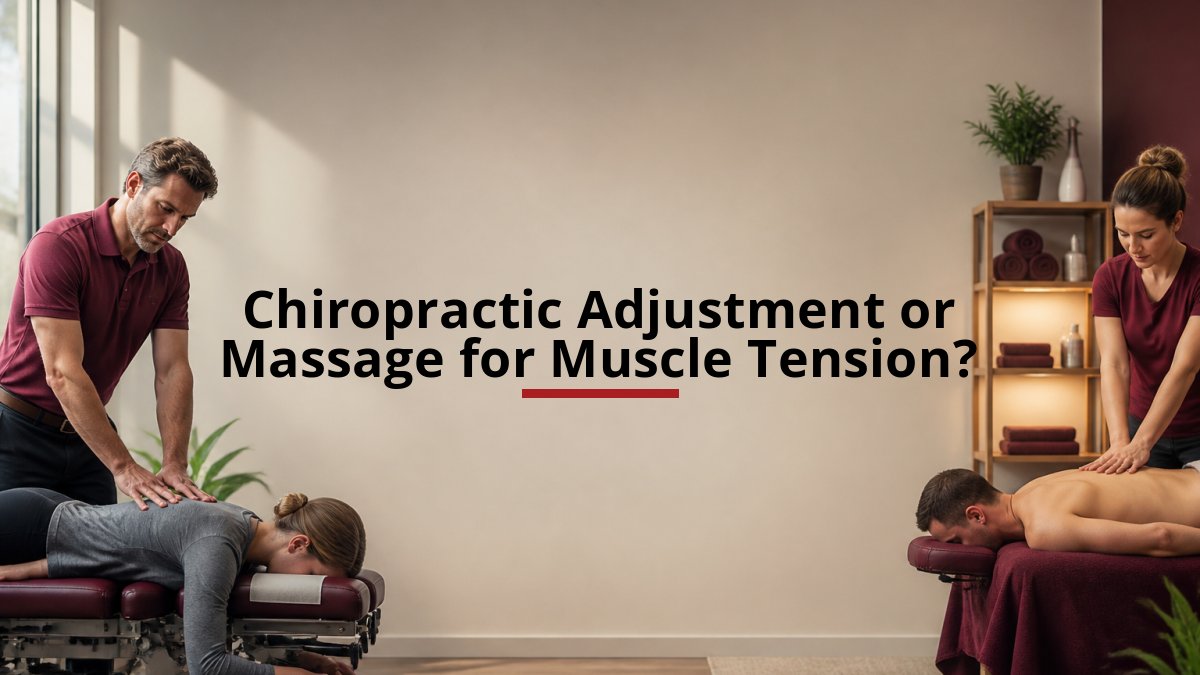
Chiropractic Adjustment or Massage for Muscle Tension?
Last Updated: October 30, 2026
Quick Summary
Chiropractic adjustments vs massage depends on where your tension starts. Adjustments are short, precise thrusts aimed at joint movement, while massage works on soft tissue to ease broad muscle tightness and knots.
- Chiropractic adjustments target joint movement and alignment, usually in the neck, mid-back, or low back.
- Massage therapy works directly on muscles, tendons, and fascia to reduce tension and improve circulation.
- Joint stiffness tied to restricted motion tends to point toward adjustments.
- Widespread tightness and knots often respond better to massage therapy.
- A consultation with a qualified provider helps determine which approach fits your symptoms.
Table of Contents
- Chiropractic Adjustments vs Massage Therapy for Muscle Tension at a Glance
- How Chiropractic Adjustments Work on Tight Muscles
- How Massage Therapy for Muscle Tension Works
- When Chiropractic Care Is the Better Fit
- When Massage Therapy Is the Better Fit
- Should You Get Massage Before or After a Chiropractic Adjustment?
- How Long Muscle Tension Relief From Massage Lasts
- What to Expect at Your First Visit at Alpha Total Health in Lady Lake
- Booking a Consultation to Choose the Right Muscle Tension Treatment
- Frequently Asked Questions
Chiropractic Adjustments vs Massage Therapy for Muscle Tension at a Glance
When comparing chiropractic adjustments vs massage for tight, sore muscles, these are two of the most common hands-on approaches people try. Both can help, but they work in different ways and suit different problems.
A chiropractic adjustment is a controlled, short thrust applied to a joint, usually the spine, to improve how it moves (Spinal Manipulation: What You Need To Know). Massage therapy works directly on the soft tissue, the muscles, tendons, and fascia, to ease tension and improve circulation. One targets joint mechanics, the other targets the muscle itself.
| Factor | Chiropractic Adjustment | Massage Therapy |
|---|---|---|
| Main focus | Joint movement and alignment | Soft tissue and muscle tension |
| Session style | Short, precise joint treatment | Longer, hands-on tissue work |
| Best suited for | Stiffness tied to joint restriction | Widespread tightness and knots |
| Typical effect | Improved joint motion | Relaxed, less tense muscles |
Pros of chiropractic adjustments: Targets joint restriction directly, often provides quick improvement in range of motion, and fits well into an ongoing care plan.
Cons of chiropractic adjustments: Some people feel sore afterward, and it does less for broad muscle tension that is not linked to a joint problem.
Pros of massage therapy: Relaxes large areas of tight muscle, feels calming, and can be scheduled as a regular habit.
Cons of massage therapy: Relief often fades within days, and it does not change joint alignment.
How Chiropractic Adjustments Work on Tight Muscles
When a joint loses normal motion, nearby muscles often tighten in response. A chiropractic adjustment aims to restore that motion. The provider uses a brief, controlled force on a specific joint, commonly in the neck, mid-back, or low back.
Tight muscles often feel better once the joint moves more freely, because the muscles around a restricted joint are frequently guarding it. Restoring joint motion can reduce that guarding. Adjustments are most useful when the tightness follows a pattern tied to a stiff joint rather than spread evenly across a body region.
A consultation is the right starting point for deciding whether an adjustment suits your symptoms. A qualified provider typically examines how your joints move before recommending any treatment.
How Massage Therapy for Muscle Tension Works
Massage therapy uses pressure, stretching, and kneading to work on muscle tissue directly. A licensed massage therapist may focus on a particular area, such as the upper back and shoulders, or treat the body more broadly.

The main goal is to reduce muscle tension and help the body relax. Massage can also make it easier to move stiff muscles during daily activities. Because it works on the soft tissue rather than the joints, it is often a good fit when tightness feels like a knot or band of tension across a large area.
When Chiropractic Care Is the Better Fit
Chiropractic care tends to be the better choice when muscle tension comes with joint stiffness, limited range of motion, or a pattern of recurring pain in the same spot. To weigh the options, compare chiropractic care and physical therapy results side by side. For example, a person who wakes up with a stiff neck that does not loosen with stretching may benefit more from joint-focused care.
Golfers who notice hip or back stiffness limiting their swing often ask about adjustments first, because the restriction is usually in the joints. A consultation with a qualified provider can help you understand whether adjustments match the pattern you are experiencing.
When Massage Therapy Is the Better Fit
Massage therapy often suits people whose muscles feel tight, sore, or knotted across a broad area without a clear joint problem. Long hours at a desk, physical work, or stress can all leave muscles in this state.
Massage is also a practical choice for people who prefer a relaxing, low-impact session. It can complement other care when the goal is to keep muscles loose between visits.
Should You Get Massage Before or After a Chiropractic Adjustment?
There is no single right answer, and the timing depends on your condition. Many people find that a gentle massage before an adjustment helps loosen surrounding muscles, which can make the joint easier to treat. Others prefer to schedule massage after an adjustment to ease any soreness.
A common mistake is booking both on the same day without checking with a provider first. Ask your clinician how they want the two combined for your specific situation.
How Long Muscle Tension Relief From Massage Lasts
Relief from a single massage session often lasts a few days, though this varies by person, activity level, and the severity of the tension. For practical guidance on heat or ice for tight muscles between treatments, see when each one helps. Regular sessions tend to extend the benefit over time, because the muscles have less chance to tighten back up between treatments.
Relief from a chiropractic adjustment depends more on whether the joint problem is improving. Many patients think of adjustments as part of a care plan rather than a one-time fix. A consultation can help set realistic expectations for your case.
What to Expect at Your First Visit at Alpha Total Health in Lady Lake
A first visit typically begins with a conversation about your symptoms, health history, and goals, followed by an examination of how you move and where you feel tension. You can also learn about the clinicians and their years of experience serving Lady Lake, The Villages, and Leesburg before you book.
Based on that exam, a provider can explain whether chiropractic care, massage, or another approach fits your needs. Adjustments are not right for every condition, and a good provider will tell you honestly if another option is a better fit.
Do you accept walk-ins? Scheduling an appointment is recommended. Please contact Alpha Total Health directly to ask about current availability.
Do you treat sciatica? Whether care is appropriate for leg pain or sciatica-like symptoms depends on a professional evaluation. Contact Alpha Total Health to schedule a consultation and discuss your symptoms.
Do you treat neuropathy? People with tingling, numbness, or burning sensations can book a consultation to discuss their symptoms with a qualified professional.
Alpha Total Health offers a New Patient Consultation Package to help you understand your options before committing to a treatment plan. The Focused Shockwave Pain Mapping visit and the Spinal Disc Decompression evaluation may also be discussed at your consultation, depending on your needs. Learn more about chiropractic care in Lady Lake and what happens at a chiropractic consultation.
Booking a Consultation to Choose the Right Muscle Tension Treatment
Choosing between a chiropractic adjustment and massage therapy comes down to where your tension starts and how it behaves. Joint stiffness points toward adjustments, while widespread muscle tightness often points toward massage. Many people benefit from a combination, but the right mix depends on a proper evaluation.
If you are in Lady Lake or The Villages and are unsure which option fits, Alpha Total Health offers a New Patient Consultation to help you decide. Get started with chiropractic care for mobility and comfort in Lady Lake and feel the difference a tailored plan can make.
Frequently Asked Questions
Is massage or chiropractic care better for muscle tension?
Neither is better for every case. Massage therapy works directly on the soft tissue, relaxing tight muscles and improving circulation, which suits people whose tension is mostly muscular. Chiropractic adjustments target joint movement and spinal alignment, and many patients use them when tight muscles are tied to restricted joints or a spinal problem. A consultation with a qualified provider can help determine which approach, or a combination, fits your situation.
Can a chiropractic adjustment help tight muscles?
Chiropractic adjustments can ease muscle tension that is linked to restricted joint motion, because restoring movement in a joint often reduces the protective guarding of nearby muscles. Many patients notice looser muscles after an adjustment, though the effect varies by person. Adjustments are not a substitute for a full evaluation, and a provider can explain whether they suit your specific condition.
Should I get a massage before or after a chiropractic adjustment?
Many providers suggest a massage before an adjustment, because loosening the surrounding muscles can make joint movement easier to restore. Some patients prefer massage afterward to ease any soreness. The right order depends on your condition and your provider's plan, so ask your chiropractor or massage therapist how they coordinate care if you use both.
How long does muscle tension relief from massage last?
The relief from a single massage session often lasts from a few hours to several days, depending on the severity of the tension, your activity level, and how consistently you manage stress and posture. Regular sessions tend to extend the benefit. Talk with a licensed massage therapist about a schedule that fits your needs.