
 how-to
Chiropractic Adjustment for Shoulder Mobility: A How-To Guide
Table of Contents
- What Chiropractic Adjustment for Shoulder Mobility Involves
- Understanding Limited Shoulder Range of Motion
- Shoulder Mobility Exercises to Support Your Adjustment
- Chiropractic Care for Shoulder Stiffness: What to Expect
- Benefits of Improved Shoulder Mobility
- Potential Risks and Considerations
- When to Seek Care for Shoulder Pain
- Common Mistakes to Avoid
- Conclusion
- Frequently Asked Questions
Last Updated: October 17, 2026
What Chiropractic Adjustment for Shoulder Mobility Involves
Chiropractic adjustment for shoulder mobility is a hands-on technique that realigns the bones and joints in your shoulder to restore movement and reduce pain. At Alpha Total Health in Lady Lake, we use targeted adjustments to address restrictions that build up over time, whether from injury, overuse, or simply aging.
The adjustment process works by applying controlled force to joints that have lost their normal range of motion. When vertebrae or shoulder joints shift out of alignment, they limit how far your arm can move. A chiropractor identifies these restrictions and gently moves the joint back into proper position.
Many people think chiropractic care is only for the spine. The reality is different. Your shoulder is one of the most mobile joints in your body, and also one of the most vulnerable. Restricted shoulder mobility affects everything from reaching overhead to sleeping comfortably at night.
How the adjustment process works
During a chiropractic adjustment for shoulder mobility, your chiropractor applies precise pressure to restore joint alignment. The goal is to remove restrictions that prevent normal movement.
Here's what happens:
- Your chiropractor examines your shoulder to find where movement is limited
- They position your arm in a specific way to target the restricted area
- A quick, controlled thrust restores proper joint alignment
- You may hear a popping sound, this is normal and harmless
- The adjustment typically takes just a few minutes
The sensation varies. Some people feel immediate relief. Others notice improvement over the next few hours as inflammation decreases and muscles relax.
Why shoulder mobility matters
Your shoulder needs to move in multiple directions. You reach forward to grab something. You lift your arm overhead. You rotate your arm behind your back. When one of these movements becomes difficult or painful, it affects your daily life.
Limited shoulder mobility makes simple tasks harder:
- Reaching for items on high shelves
- Putting on a jacket or shirt
- Throwing a ball or playing golf
- Sleeping on your side
- Driving comfortably
The longer you ignore restricted shoulder mobility, the more your body compensates. You start using different muscles or moving differently to avoid pain. This creates new problems elsewhere, often in your neck or lower back.
Understanding Limited Shoulder Range of Motion
Limited shoulder range of motion develops gradually. It rarely appears overnight. Understanding how restrictions build helps you recognize when to seek care.
Common causes of restricted movement
Your shoulder loses mobility for several reasons. The most common include:
- Rotator cuff strain, overuse or minor injury to the muscles and tendons around your shoulder
- Frozen shoulder, gradual stiffening that develops without a clear cause, often in people over 50
- Arthritis, wear and tear on the shoulder joint that narrows movement
- Poor posture, slouching or forward head position tightens shoulder muscles
- Repetitive motion, golf, tennis, or overhead work that strains the joint
- Injury or trauma, falls, accidents, or sports injuries that damage soft tissue
- Inactivity, long periods without movement cause muscles to tighten
In Lady Lake, we see many retirees and active golfers whose shoulder restrictions stem from years of repetitive motion or simply aging. The good news is that most cases respond well to chiropractic adjustment for shoulder mobility when caught early.
How restrictions develop over time
Shoulder mobility doesn't disappear suddenly. It fades gradually as your body adapts to pain or discomfort.
The pattern usually looks like this:
First, something causes mild irritation, a small strain, poor sleeping position, or repetitive activity. You might not even notice at first.
Next, your body protects the area by tightening muscles around the shoulder. This is a natural defense response. The tightness limits movement to prevent further injury.
Over weeks or months, the muscles stay tight. Your shoulder learns to move less. You stop reaching as far or lifting as high. Movement becomes restricted without you realizing how much you've lost.
Finally, the joint itself starts to stiffen. Cartilage doesn't get the movement it needs to stay healthy. Inflammation builds. What started as a minor irritation becomes a real mobility problem.
This is why early intervention matters. A chiropractic adjustment for shoulder mobility works best before the restriction becomes severe.
Shoulder Mobility Exercises to Support Your Adjustment
Chiropractic adjustments restore mobility. Exercises maintain it. The two work together.
After your adjustment, specific exercises help your shoulder stay mobile and strong. These aren't intense workouts. They're gentle movements designed to reinforce what the adjustment achieved.
Gentle range-of-motion exercises
Start with these basic movements. Do them slowly and stop if you feel sharp pain.
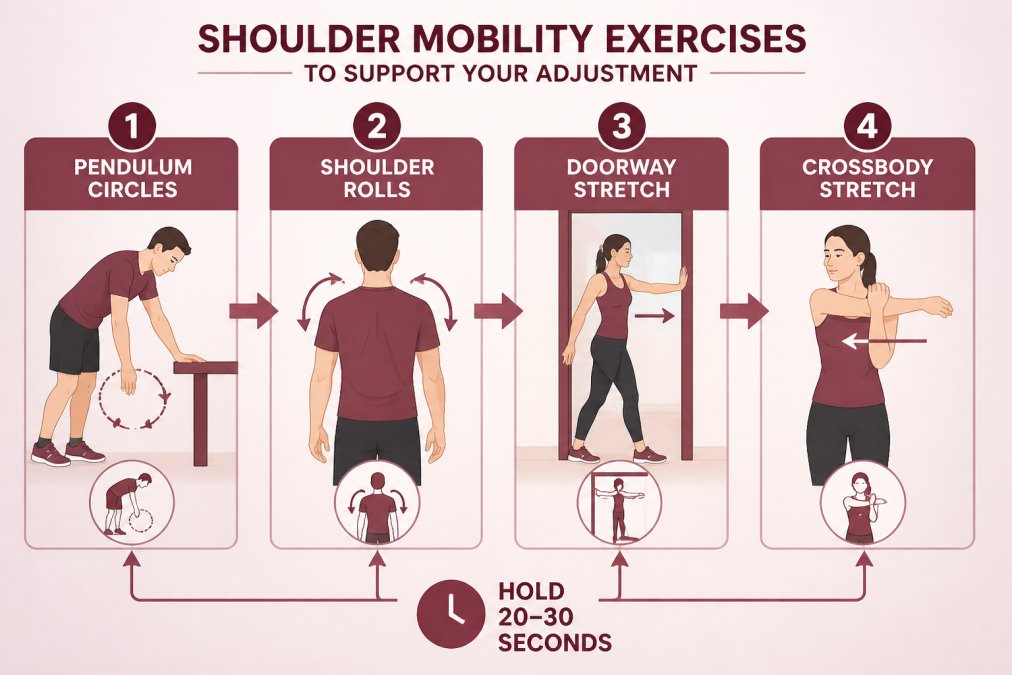
Pendulum circles, Stand with good posture. Let one arm hang down. Gently swing it in small circles, gradually making the circles larger. Do 10 circles each direction. Repeat on the other side. This movement warms up the shoulder without forcing it.
Shoulder rolls, Lift both shoulders up toward your ears. Roll them back and down. Feel the stretch across your chest and shoulders. Do 8-10 slow rolls forward, then 8-10 backward. This releases tension in the upper back and shoulders.
Doorway stretch, Stand in a doorway. Place your forearm on the frame with your elbow at shoulder height. Step forward gently until you feel a stretch across your chest. Hold for 20-30 seconds. Repeat 2-3 times on each side. This opens up the front of your shoulder.
Crossbody shoulder stretch, Bring one arm across your body at shoulder height. Use your other hand to gently pull it closer. Hold for 20-30 seconds. Repeat 3 times on each side. This stretches the outer shoulder muscle.
Strengthening exercises for long-term stability
Once gentle range-of-motion exercises feel comfortable, add light strengthening work. Strong muscles protect your shoulder and prevent future restrictions.
Resistance band rows, Anchor a resistance band at chest height. Pull the band toward you, squeezing your shoulder blades together. Hold for 2 seconds. Release slowly. Do 12-15 repetitions. This strengthens the muscles that stabilize your shoulder.
Scapular wall slides, Stand with your back against a wall. Place your arms in a "W" position at shoulder height. Slowly slide them up the wall into a "Y" position. Slide back down. Do 10-12 repetitions. This builds strength in the muscles that support shoulder mobility.
Light shoulder presses, Hold light dumbbells or water bottles at shoulder height. Press them overhead in a controlled motion. Lower slowly. Do 10-12 repetitions. Start light and increase weight gradually only as strength improves.
These exercises complement your chiropractic adjustment for shoulder mobility. They help your shoulder stay mobile and prevent restrictions from returning.
Chiropractic Care for Shoulder Stiffness: What to Expect
Chiropractic care for shoulder stiffness follows a clear process. Knowing what to expect helps you feel confident about your decision.
Initial evaluation and assessment
Your first visit focuses on understanding your shoulder problem. Your chiropractor will ask detailed questions about your symptoms, when they started, what makes them worse, and what activities you've had to limit.
Then comes a physical examination. Your chiropractor will:
- Check your shoulder's range of motion in all directions
- Feel the joints and muscles for restrictions or misalignment
- Test muscle strength and nerve function
- Ask you to perform specific movements to identify problem areas
Some patients worry about x-rays. We don't take x-rays here but will refer out for imaging when necessary. Most shoulder mobility issues can be diagnosed through physical examination alone.
After the evaluation, your chiropractor explains what they found and recommends a treatment plan. This is your chance to ask questions and understand the approach.
The adjustment session
The actual adjustment is typically brief, often just 5-10 minutes of hands-on work. Your chiropractor positions your shoulder and applies controlled force to restore alignment.
You remain clothed during the adjustment. Your chiropractor may ask you to move your arm in specific ways to guide the adjustment. Communication is important. Tell your chiropractor if anything feels uncomfortable.
Most adjustments feel good. Many people experience immediate relief. Others notice improvement over the next few hours as inflammation decreases and muscles relax.
Recovery and aftercare
After your adjustment, your shoulder may feel slightly tender for a few hours. This is normal. Ice or heat can help, use whichever feels better.
Your chiropractor will recommend:
- How often to return for follow-up adjustments
- Which exercises to do at home
- Activities to avoid temporarily
- When to expect noticeable improvement
Follow these recommendations. Consistency matters. Regular adjustments combined with home exercises produce the best results.
Most people notice improvement within 2-4 weeks of starting chiropractic care for shoulder stiffness. Significant improvement often takes 4-8 weeks depending on how long the restriction has been present.
Benefits of Improved Shoulder Mobility
Restoring shoulder mobility changes your life in practical ways. You regain abilities you may have taken for granted.
Restored function for daily activities
When your shoulder moves freely, everyday tasks become easy again. You can reach overhead without pain. You can sleep on your side comfortably. You can throw a ball or play golf without limitation.
For active retirees in Lady Lake and The Villages, this means returning to the activities you love. Golfers regain their full swing. People return to pickleball without pain. Couples feel more comfortable during intimate moments.
Simple tasks feel better too. Putting on a jacket. Reaching for items on shelves. Driving without discomfort. These small victories add up to a better quality of life.
Pain reduction and improved comfort
Pain often drives people to seek help. Improved shoulder mobility eliminates the pain that restricted your movement in the first place.
When your shoulder joint is properly aligned, inflammation decreases. Muscles relax. Nerves stop sending pain signals. The result is genuine comfort, not just temporary relief from medication.
This pain reduction lasts. It's not about masking symptoms. It's about fixing the underlying problem so your shoulder works the way it should.
Potential Risks and Considerations
Chiropractic adjustment for shoulder mobility is generally safe. Understanding potential risks helps you make an informed decision.
Temporary soreness after adjustment
Some patients experience mild soreness after an adjustment (Adverse effects of spinal manipulation: a systematic review). This is similar to muscle soreness after exercise. It typically resolves within 24-48 hours.
Soreness is different from pain. Soreness feels like a dull ache. Pain is sharp or severe. If you experience significant pain after an adjustment, contact your chiropractor immediately.
To minimize soreness:
- Use ice or heat as recommended
- Stay hydrated
- Avoid strenuous activity for 24 hours
- Do your prescribed home exercises gently
Most people find the temporary soreness worthwhile because of the mobility improvement that follows.
When adjustments may not be appropriate
Chiropractic adjustment for shoulder mobility works well for most people. Some conditions require different approaches.
Your chiropractor may recommend other treatments if you have:
- Severe fractures or breaks
- Advanced arthritis requiring surgical intervention
- Certain neurological conditions
- Recent surgery on your shoulder
- Specific medical conditions that contraindicate manipulation
This is why the initial evaluation matters. Your chiropractor identifies these situations and recommends appropriate alternatives. Sometimes chiropractic care works alongside other treatments. Sometimes other approaches are better.
Honesty about your health history helps your chiropractor recommend the right path forward.
When to Seek Care for Shoulder Pain
Not every shoulder problem requires immediate attention. Some resolve on their own. Others need professional care.
Red flags that warrant professional evaluation
Seek care if you experience:
- Shoulder pain that lasts more than a few days
- Pain that worsens despite rest
- Significant limitation in movement
- Pain that affects sleep or daily activities
- Numbness or tingling in your arm or hand
- Weakness in your shoulder or arm
- Pain following an injury or fall
- Pain that comes and goes but keeps returning
These symptoms suggest an underlying problem that won't resolve without intervention. Early care prevents minor issues from becoming serious ones.
In Lady Lake, many residents wait too long hoping shoulder pain will go away on its own. By the time they seek help, the restriction has become more severe. Starting care sooner means faster improvement.
Getting started with a consultation
The first step is a consultation. During this visit, your chiropractor listens to your concerns and performs an initial evaluation. Alpha Total Health offers a $49 New Patient Visit designed to introduce you to our approach and give you a clear picture of what's happening with your shoulder and what treatment looks like.
Come prepared to discuss:
- When your shoulder problem started
- What makes it better or worse
- What activities you want to return to
- Your health history
- Any previous treatments you've tried
This information helps your chiropractor create a personalized plan.
Common Mistakes to Avoid
People often make choices that delay recovery from shoulder mobility problems.
Ignoring early warning signs, Pain that comes and goes is your body's signal that something needs attention. Waiting until pain is constant means the problem has progressed further.
Pushing through pain, Continuing activities that cause pain doesn't build strength. It usually makes things worse. Rest and proper care come first.
Skipping home exercises, The adjustment restores mobility. Exercises maintain it. Skipping exercises means restrictions often return.
Expecting overnight results, Shoulder mobility restrictions develop over months or years. Improvement takes time. Most people see real progress within 4-8 weeks of consistent care.
Trying only one approach, Adjustments work best combined with exercises and activity modification. Relying on adjustments alone produces limited results.
Not communicating with your chiropractor, Tell your chiropractor if something isn't working or if you're having trouble with home exercises. They adjust the plan based on your feedback.
Conclusion
Shoulder mobility matters more than most people realize. Limited movement affects your daily life, your activities, and your quality of life. Chiropractic adjustment for shoulder mobility restores what you've lost.
The process is straightforward. An evaluation identifies the restriction. An adjustment restores alignment. Exercises maintain improvement. Most people experience real results within weeks.
At Alpha Total Health in Lady Lake, we've spent over 29 years helping people restore shoulder mobility through founder-led chiropractic care. Our approach combines hands-on adjustments with personalized exercise plans and expert guidance. We understand what active retirees, golfers, and people managing chronic pain actually need.
If shoulder stiffness is limiting your life, start with a consultation. Our $49 New Patient Visit introduces you to our approach and creates a clear path forward. You don't have to live with restricted shoulder mobility. Restoration is possible.
Frequently Asked Questions
Can a chiropractic adjustment improve shoulder mobility?
Yes. Chiropractic adjustments address joint restrictions and misalignments that limit shoulder movement. By restoring proper alignment and reducing muscle tension, adjustments can increase your range of motion. Results vary based on the cause of your restriction and how long the problem has existed. A qualified chiropractor will evaluate your specific situation during a consultation to determine whether adjustment is appropriate for your condition.
What should I do if I have limited shoulder range of motion?
Start by identifying when the restriction began and what activities make it worse. Gentle stretching and avoiding aggravating movements can help temporarily. However, if limited shoulder range of motion persists beyond a few days, affects your daily activities, or worsens over time, professional evaluation is important. A chiropractor can assess whether joint restrictions, muscle tightness, or other factors are responsible and recommend appropriate care.
What shoulder mobility exercises can I do at home?
Effective shoulder mobility exercises include arm circles (small to large), cross-body shoulder stretches, and gentle pendulum swings. Strengthening exercises like resistance band rows and wall push-ups support long-term stability. Always move within a comfortable range and avoid forcing movement into pain. If you're new to these exercises or have existing shoulder issues, ask your chiropractor which movements are safe for your situation before starting a routine.
When should I see a healthcare provider about shoulder pain?
Seek professional care if shoulder pain is severe, follows an injury, lasts more than a few days, limits your ability to work or enjoy activities, or is accompanied by numbness, tingling, or weakness. Pain that wakes you at night or restricts your range of motion also warrants evaluation. A chiropractor or physician can determine the cause and recommend the most appropriate treatment path for your needs.
American Chiropractic Association guidance on shoulder care
Mayo Clinic information on shoulder mobility and frozen shoulder
National Institutes of Health research on musculoskeletal disorders and mobility