 ultimate-guide
Can Regenerative Medicine Help Chronic Back Pain?
Table of Contents
- What Is Regenerative Medicine for Back Pain?
- How Regenerative Medicine Works for Chronic Back Pain
- Conditions Treatable with Regenerative Therapies
- Regenerative Medicine vs. Traditional Back Pain Treatments
- Cost of PRP Treatment and Regenerative Procedures
- Is Regenerative Medicine Covered by Insurance?
- Regenerative Medicine Recovery Time and Expectations
- Who Should and Shouldn't Pursue Regenerative Therapies
- Frequently Asked Questions
Last Updated: September 20, 2026
What Is Regenerative Medicine for Back Pain?
Regenerative medicine uses the body's own healing mechanisms to repair damaged tissues. For chronic back pain, can regenerative medicine help by addressing underlying tissue damage rather than simply masking symptoms with medication or temporarily relieving pain through conventional treatments. (Source: National Institutes of Health (NIH) on stem cell research)
Unlike traditional pain management that focuses on symptom relief, regenerative medicine targets the root cause by introducing concentrated growth factors, healing cells, or platelets directly into the damaged area, stimulating the body's natural repair processes.
The approach uses orthobiologics, biological substances derived from the patient's own body, to promote tissue regeneration, shifting the treatment paradigm from temporary relief to potential long-term structural improvement.
How Regenerative Medicine Works for Chronic Back Pain
Regenerative therapies interrupt the damage cycle by introducing healing-promoting substances directly into the affected area, stimulating cellular repair and reducing inflammatory responses.
Regenerative therapies concentrate growth factors and healing cells that naturally exist in the body, then deliver them precisely where tissue damage has occurred, amplifying the natural healing process.
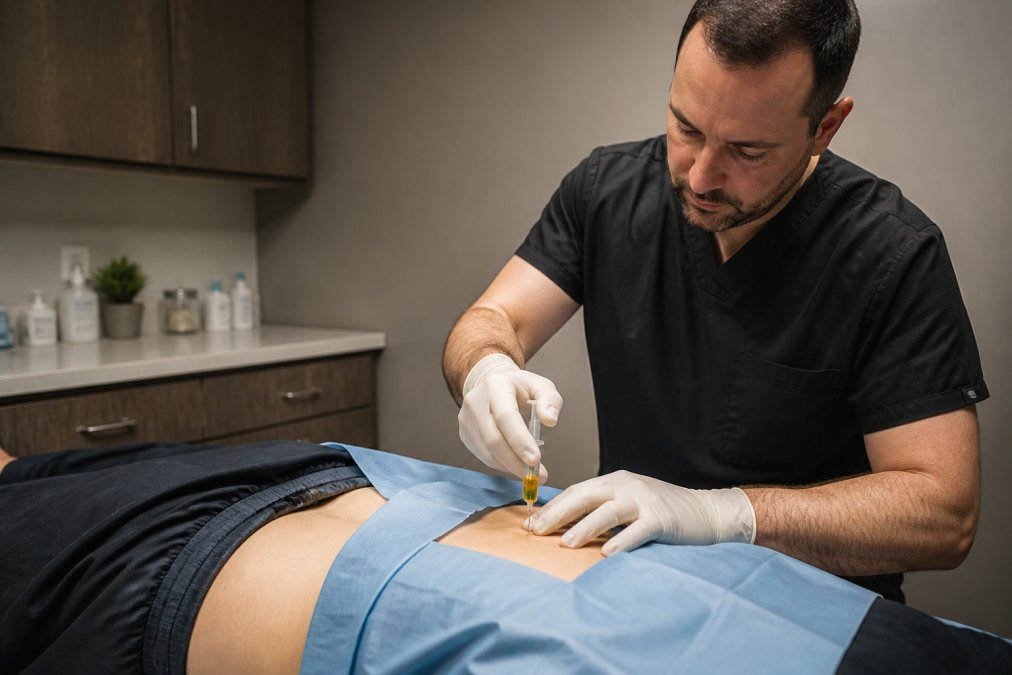
Stem Cell Therapy and Tissue Repair
Stem cell therapy harvests cells from bone marrow or fat tissue, concentrates them, and injects them into areas of disc degeneration or ligament damage. These cells can differentiate into disc cells, cartilage, or supportive tissue, addressing structural problems at the cellular level.
Stem cells release healing compounds that reduce inflammation and stimulate the body's own repair mechanisms, addressing underlying problems rather than managing symptoms (pubmed.ncbi.nlm.nih.gov).
Platelet-Rich Plasma (PRP) Therapy
Platelet-Rich Plasma therapy concentrates platelets from the patient's own blood, which contain growth factors and healing proteins that accelerate the body's repair response when injected into damaged spinal structures (pubmed.ncbi.nlm.nih.gov).
Blood is drawn, processed to concentrate platelets, and injected into the damaged area. PRP works by delivering growth factors that reduce inflammation, promote cellular proliferation, and strengthen healing tissue, making it particularly effective for ligament sprains, disc tears, and early-stage degenerative changes.
Bone Marrow Aspirate Concentrate (BMAC)
BMAC combines stem cells with healing growth factors from bone marrow, harvested from the pelvis and injected into damaged spinal structures to provide both cellular regeneration and inflammatory modulation.
Conditions Treatable with Regenerative Therapies
Regenerative medicine shows promise for herniated discs, degenerative disc disease, spinal stenosis, facet joint arthritis, and ligament injuries by promoting healing and reducing inflammation.
Suitability depends on the specific condition, its severity, and overall health. Imaging confirms the underlying structural problem before treatment begins.
Regenerative Medicine vs. Traditional Back Pain Treatments
Traditional back pain management, physical therapy, anti-inflammatory medications, epidural steroid injections, and surgery, addresses symptoms rather than underlying tissue damage.
Regenerative medicine aims to stimulate actual tissue repair and regeneration rather than managing pain. While epidural steroid injections provide temporary relief, regenerative therapy promotes gradual tissue repair over weeks and months.
Traditional treatments provide faster pain relief, while regenerative therapies require longer to show results as tissue repair unfolds.
| Treatment Approach | Mechanism | Timeline | Best For |
|---|---|---|---|
| Physical Therapy | Strengthens supporting muscles | Weeks to months | Prevention, early degeneration |
| Anti-inflammatory Medication | Reduces inflammation temporarily | Days to weeks | Acute flare-ups |
| Epidural Steroid Injection | Delivers steroids to reduce nerve inflammation | Weeks to months | Nerve-related pain |
| Regenerative Medicine | Stimulates tissue repair and regeneration | Weeks to months | Structural damage, disc degeneration |
| Surgical Intervention | Removes or stabilizes damaged structures | Immediate stabilization | Severe stenosis, instability |
Cost of PRP Treatment and Regenerative Procedures
Unlike traditional back surgery, which insurance often covers, regenerative therapies are frequently classified as elective or investigational. Understanding costs and financial options is essential for informed decision-making.
Understanding the Financial Landscape
Ask your provider for a detailed breakdown of what's included: the procedure, consultations, follow-up visits, and whether physical therapy is bundled. Some practitioners offer package pricing for multi-session protocols.
Comparing Long-Term Financial Impact
Consider the long-term financial picture. Ongoing physical therapy, medications, and injections accumulate costs over years without addressing the underlying problem. Regenerative medicine represents a higher upfront investment with potential to reduce future healthcare spending.
Is Regenerative Medicine Covered by Insurance?
Insurance coverage for regenerative medicine varies significantly by plan and procedure. Many classify these therapies as experimental or investigational, meaning they are not covered, though policies continue to evolve.
Regenerative Medicine Recovery Time and Expectations
Recovery unfolds in distinct phases with specific expectations and activity guidelines. Unlike surgical recovery, regenerative medicine recovery reflects the biological pace of tissue repair over weeks and months.
Immediate Post-Procedure Phase (Days 1-7)
Most patients experience minimal discomfort from the minimally invasive injection. The injection site may feel sore for 24-48 hours, with mild bruising or swelling that typically resolves within a few days.
Early Healing Phase (Weeks 2-4)
After the first week, gradual activity progression begins with post-procedure physical therapy. Patients work with a physical therapist to gently mobilize the spine, activate stabilizing muscles, and restore movement patterns.
Active Regeneration Phase (Weeks 4-12)
Meaningful improvement typically emerges over 4-12 weeks as tissue repair accelerates. Some patients notice gradual improvement within 2-3 weeks, while others require the full 12-week period for maximum benefit. This timeline differs significantly from epidural steroid injections, which often provide relief within days, but reflects the biological reality of tissue regeneration.
Expected Outcome Timeline
Week 1-2: Minimal discomfort, activity restrictions observed, early inflammation begins to decrease.
The Role of Physical Therapy in Regenerative Success
Physical therapy is not optional, it's integral to regenerative medicine success. The injected cells and growth factors create an environment for healing, but your movement patterns, muscle activation, and spinal stability determine whether that healing translates into lasting functional improvement. A patient who receives regenerative therapy but skips physical therapy may experience temporary pain relief without the structural improvement that makes the treatment worthwhile.
Realistic Expectations
Regeneration takes time. This is fundamentally different from the immediate pain relief many patients expect from injections or medications. However, the trade-off is meaningful: rather than temporary symptom relief, regenerative medicine offers the potential for actual tissue improvement. A patient receiving an epidural steroid injection may feel better within days but the underlying disc degeneration continues.
Who Should and Shouldn't Pursue Regenerative Therapies
Regenerative medicine works best for individuals with specific structural problems and realistic expectations about the healing timeline. Candidates typically have imaging confirmation of tissue damage, degenerative discs, ligament injuries, or cartilage breakdown, and have not achieved adequate relief through conservative treatment. Age alone is not a barrier; many individuals in their 60s and 70s respond well to regenerative therapies because the approach works with the body's own healing capacity rather than against it.
Frequently Asked Questions
What is the success rate of regenerative medicine for chronic back pain?
Success rates vary depending on the specific condition, treatment type, and patient factors. Clinical studies show that patients often experience reduced inflammation, improved mobility, and decreased pain levels. However, outcomes are not guaranteed, and results depend on the severity of degeneration, the procedure chosen, and adherence to post-treatment physical therapy. A consultation with a qualified provider can help set realistic expectations for your specific situation.
How long is the recovery time after regenerative medicine treatment?
Recovery timelines differ based on the procedure. Most patients can resume light activities within days, though full recovery typically takes 4-12 weeks. During this period, post-procedure physical therapy is essential to maximize tissue healing and functional improvement. Your provider will give specific restrictions and a progressive return-to-activity plan. Many patients report gradual pain reduction over weeks to months as the regenerative process continues.
Does insurance cover the cost of regenerative medicine or PRP therapy?
Insurance coverage for regenerative therapies remains limited. Most major insurance plans classify stem cell therapy, PRP, and BMAC procedures as experimental or elective, meaning they may not be covered. Coverage varies significantly by insurer and plan type. Contact your insurance provider directly to understand your specific policy. Many patients explore flexible payment options or financing plans with their healthcare provider to manage out-of-pocket costs.
Can regenerative medicine work for someone over 65 with long-standing back problems?
Age alone is not a barrier to regenerative therapy. Older adults can benefit from these treatments, as the body retains the ability to respond to growth factors and tissue-repair signals. However, factors like the extent of degeneration, overall health status, and adherence to post-treatment rehabilitation influence outcomes. A comprehensive evaluation is needed to determine candidacy and realistic goals. Many active adults in their 60s and beyond have experienced improved mobility and reduced pain with appropriate regenerative treatment.
What conditions can regenerative medicine actually treat in the spine?
Regenerative therapies address several spinal and musculoskeletal conditions, including degenerative disc disease, herniated discs, spinal stenosis, facet joint arthritis, and soft tissue injuries. These treatments work by reducing inflammation, promoting tissue repair, and restoring structural integrity. However, not all back pain stems from conditions suitable for regenerative approaches. A clinical evaluation determines whether your specific diagnosis is a good candidate for these minimally invasive options.
How is regenerative medicine different from chiropractic adjustments alone?
Chiropractic care focuses on spinal alignment and mobility through manual techniques. Regenerative medicine uses your body's own healing cells and growth factors to repair damaged tissue at the cellular level. While both can reduce pain and improve function, regenerative therapies address underlying tissue degeneration directly. A comprehensive approach may combine both modalities, chiropractic care for alignment and mobility, plus regenerative therapy for tissue repair, to address chronic back pain from multiple angles.
What should I expect during and after a regenerative medicine procedure?
The procedure itself is minimally invasive, typically taking 30-60 minutes in an outpatient setting. You receive a local anesthetic, and the provider uses ultrasound or fluoroscopy to guide precise needle placement. Afterward, you may experience mild soreness or swelling at the injection site for a few days. Strict activity restrictions apply during the first 1-2 weeks to protect the healing tissue. Post-procedure physical therapy begins gradually and progresses over weeks to restore strength and function while the regenerative process takes effect.