 listicle
Best Regenerative Therapy for Golfers: Top Options
Table of Contents
- Why Golfers in Lady Lake and The Villages Turn to Regenerative Therapy
- Quick Comparison: Best Regenerative Therapy for Golfers
- Focused Shockwave Therapy for Golfers: A Non-Invasive First Step
- Chiropractic Care for Golfers: Restoring Swing Mobility
- Laser Therapy for Sports Injuries: Speeding Up Tissue Repair
- PRP, Stem Cell Therapy, Prolotherapy, BMAC, and Amniotic Injections
- Metabolic Health and Injury Recovery: Fueling Your Cells to Prevent Setbacks
- Which Regenerative Therapy Fits Your Golf Game?
- Frequently Asked Questions
Last Updated: October 7, 2026
Why Golfers in Lady Lake and The Villages Turn to Regenerative Therapy
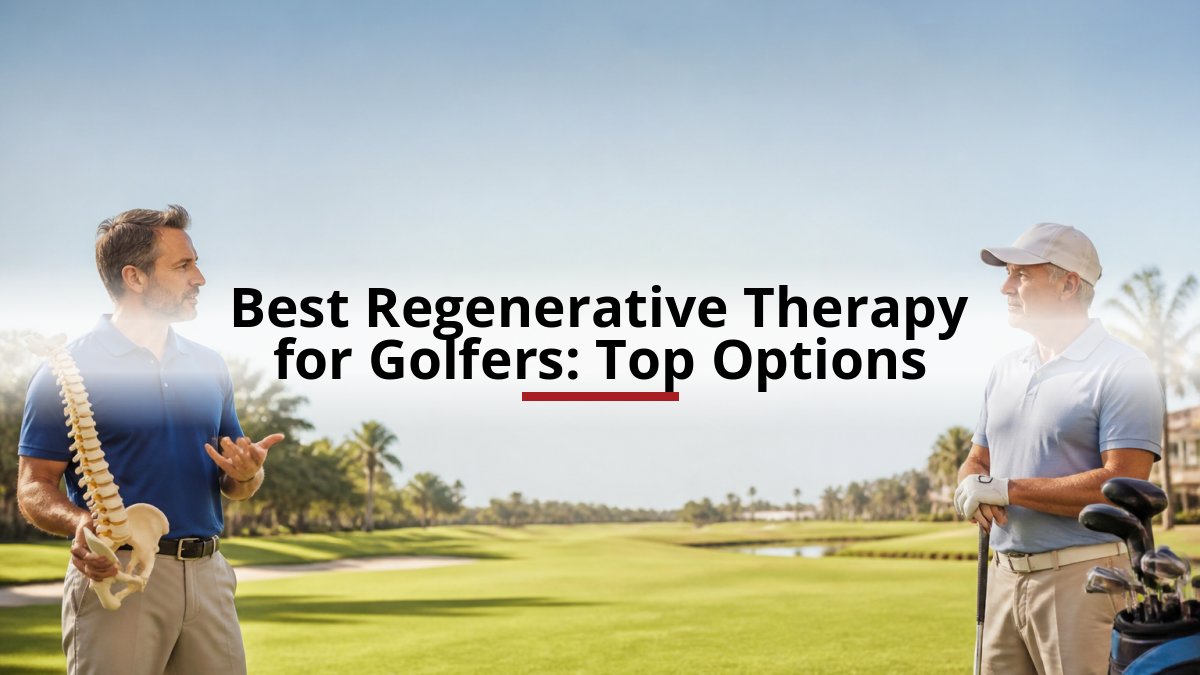
The best regenerative therapy for golfers depends on the injury, the joint, and how much downtime you can accept. For many players dealing with tendon pain, focused shockwave therapy can be a valuable first step, while chiropractic care may help restore the mobility a full swing demands. At Alpha Total Health, we've spent 29 years helping Lady Lake and The Villages golfers pursue their goals without surgery, and we've observed that players who focus on a comprehensive approach to healing often see the best results.
Regenerative therapy for golfers is a category of non-surgical treatments that use the body's own repair signals, or targeted energy, to calm inflammation and rebuild damaged tissue. The repetitive torque of a golf swing punishes the lower back, hips, elbows, and shoulders. That's why so many local players start searching for regenerative therapy for golfers near me after a season of ignored aches.
Below, we break down each option, who it suits, and how it pairs with the metabolic and recovery work that can support any therapy.
Quick Comparison: Best Regenerative Therapy for Golfers
The table below summarizes how each option compares on invasiveness, downtime, and best use case. Use it as a starting map, then read the detailed sections.
| Therapy | Invasiveness | Typical Downtime | Best For |
|---|---|---|---|
| Focused shockwave | Non-invasive | None to minimal | Tendon pain, first-line care |
| Chiropractic care | Non-invasive | None | Stiff hips, low back, swing mobility |
| Laser therapy | Non-invasive | None | Soft tissue repair, inflammation |
| PRP injections | Minimally invasive | 1-3 days | Chronic tendon and ligament injuries |
| Prolotherapy | Minimally invasive | 1-3 days | Joint instability, ligament laxity |
| Stem cell / BMAC | Minimally invasive | Several days | Advanced joint and disc degeneration |
| Amniotic allograft | Minimally invasive | 1-3 days | Acute and chronic inflammation |
A common mistake is jumping straight to the most aggressive option. In practice, considering less invasive therapies that address the root problem can often be a good starting point for a recreational golfer.
Focused Shockwave Therapy for Golfers: A Non-Invasive First Step
Focused shockwave therapy for golfers uses acoustic pressure waves to stimulate blood flow and trigger the body's own repair response in stubborn tendon and fascia tissue. There are no needles, no incisions, and no recovery period, which is why we often recommend it before considering injections.
Focused shockwave therapy may be considered for conditions like golfer's elbow, plantar fasciitis, and chronic shoulder tendinopathy. Sessions are short, and many patients return to normal activity the same day. Shockwave therapy works gradually, and a single session may not resolve a long-standing problem. Multiple visits are often needed, spaced about a week apart.
If you're weighing whether this is right for you, a consultation is the honest starting point. We do not take x-rays here, but we will refer out for imaging when necessary to confirm what's actually driving your pain.
Chiropractic Care for Golfers: Restoring Swing Mobility
Chiropractic care for golfers focuses on restoring the joint motion that a repeatable swing depends on. When the hips, pelvis, or mid-back lock up, the body compensates, and that compensation is often where pain begins.
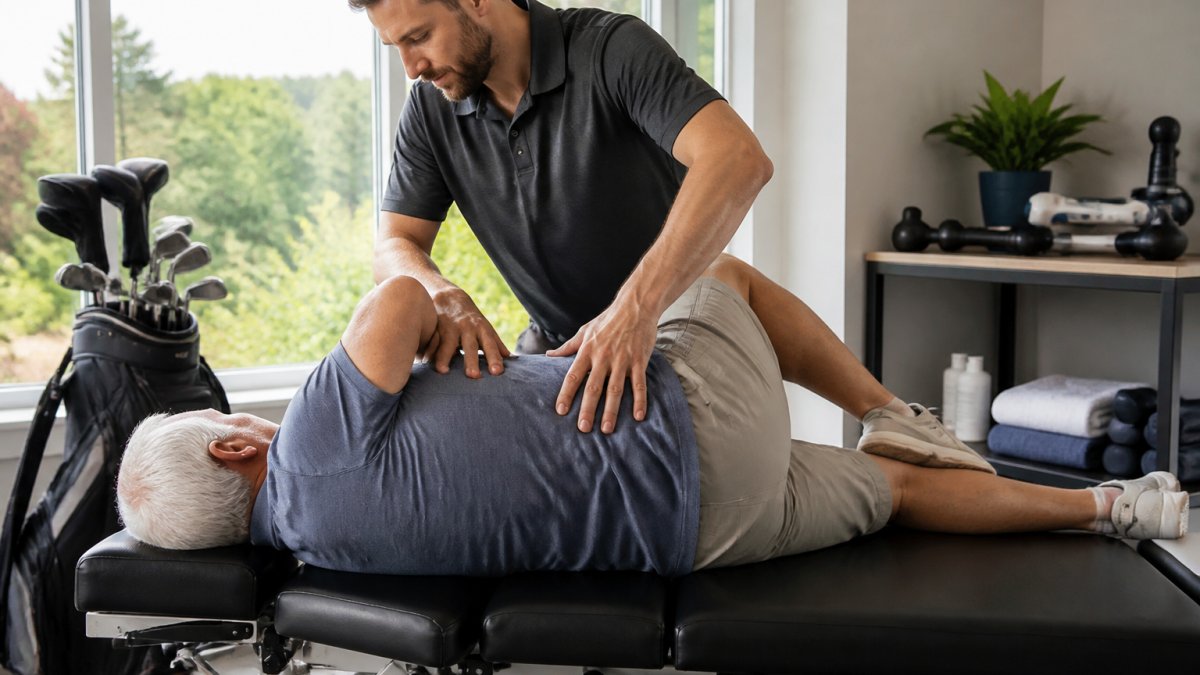
A restricted hip forces the lower back to rotate further than it should. Over hundreds of swings, that adds up. Adjustments aim to free the joint, reduce that compensation, and let you turn through the ball without guarding.
This is where our founder-led approach matters. With more than 29 years of clinical experience, we treat the swing as a movement pattern, not just a sore spot. Many patients combine adjustments with shockwave or laser work in the same plan, because mobility and tissue healing reinforce each other.
Laser Therapy for Sports Injuries: Speeding Up Tissue Repair
Laser therapy for sports injuries delivers specific wavelengths of light into damaged tissue to reduce inflammation and support cellular repair. It's painless, non-invasive, and often used alongside chiropractic adjustments or shockwave sessions.
Golfers with tendon strains, muscle tears, or lingering joint swelling often notice less discomfort after a course of treatment. The effect is cumulative, so consistency matters more than any single visit. We pair laser therapy with HEIT to stimulate a faster healing response, especially in tissue that has been irritated for months.
PRP, Stem Cell Therapy, Prolotherapy, BMAC, and Amniotic Injections
These are general descriptions, not a recommendation for any individual. Whether an injection suits you depends on your history, imaging, and goals, and that's a conversation for a qualified professional.
Metabolic Health and Injury Recovery: Fueling Your Cells to Prevent Setbacks
Metabolic health and injury recovery are directly linked: tissue that is well fueled repairs faster, and tissue that is poorly fueled stays inflamed. This is the piece most golfers skip, and it's often why progress stalls.
Cells need steady energy, adequate protein, and controlled inflammation to rebuild. When blood sugar swings, sleep is poor, or hydration is neglected, the repair process slows no matter how good the therapy is. Many of our patients in The Villages, Lady Lake, Oxford, and Wildwood find that simple changes to meals, hydration, and sleep make their other treatments work better.
We treat metabolic support as fuel, not an add-on. Combined with HEIT and laser therapy, it gives the body what it needs to heal between sessions instead of fighting itself.
Which Regenerative Therapy Fits Your Golf Game?
The right choice comes down to three questions: what's injured, how much downtime you can accept, and how your body is fueling recovery. Start non-invasive with shockwave, chiropractic, and laser. Move to injections only when the evidence and your goals support it. Support everything with metabolic health.
At Alpha Total Health, our New Patient Consultation Package is built to answer exactly that. You'll get a founder-led evaluation, a plan that fits your swing and your budget, and honest guidance on what we can and can't do. We don't guarantee outcomes, because no honest provider can, but we are dedicated to helping you achieve lasting relief and improved quality of life.
Frequently Asked Questions
What regenerative therapies may help golfers with joint or tendon pain?
Golfers dealing with chronic joint or tendon pain have several options, including focused shockwave therapy. Focused shockwave therapy is often used for tendon and connective tissue issues. A qualified provider can assess your specific injury and recommend appropriate care based on your health history and goals.
Can focused shockwave therapy help golfers recover from an injury?
Focused shockwave therapy uses acoustic waves to stimulate blood flow and tissue repair in injured tendons and muscles. For golfers, it is often used for elbow, shoulder, and hip tendon issues that limit swing power and comfort. Because it is non-invasive, many patients return to daily activities quickly. A consultation can confirm whether shockwave therapy suits your injury and whether it should be combined with chiropractic care or laser therapy.
How can chiropractic adjustments support a golfer with limited mobility?
Chiropractic care for golfers focuses on restoring joint alignment and reducing restrictions in the spine, hips, and shoulders. Limited mobility in these areas can reduce swing rotation and increase strain on other joints. Gentle adjustments, combined with soft tissue work, may improve range of motion and reduce pain. Many golfers in The Villages and Lady Lake use chiropractic care as part of a broader plan that includes shockwave, laser, or metabolic support.
Can laser therapy be used alongside shockwave therapy for golf-related pain?
Yes, laser therapy for sports injuries is often combined with shockwave therapy to address both inflammation and tissue repair. Laser therapy uses light energy to reduce pain and swelling, while shockwave stimulates healing in deeper tissues. Together, they may speed recovery and improve comfort. Your provider can determine the right sequence and frequency based on your injury and how your body responds to treatment.
Do golfers need imaging before starting treatment?
Imaging is not always required before starting regenerative therapy, but it can help identify the exact source of pain. At Alpha Total Health, we do not take x-rays on site; if imaging is needed, we refer you to a trusted imaging center. A thorough evaluation, including movement testing and health history, often guides treatment decisions. Your provider will let you know if a referral for imaging is appropriate for your situation.
Golfers in Lady Lake and The Villages shouldn't have to choose between the game they love and a body that hurts. Alpha Total Health brings 29 years of clinical experience, founder-led chiropractic care, focused shockwave therapy, laser treatment, and metabolic support together under one roof. Start with our New Patient Consultation Package and get a plan built around your swing, your goals, and your recovery.